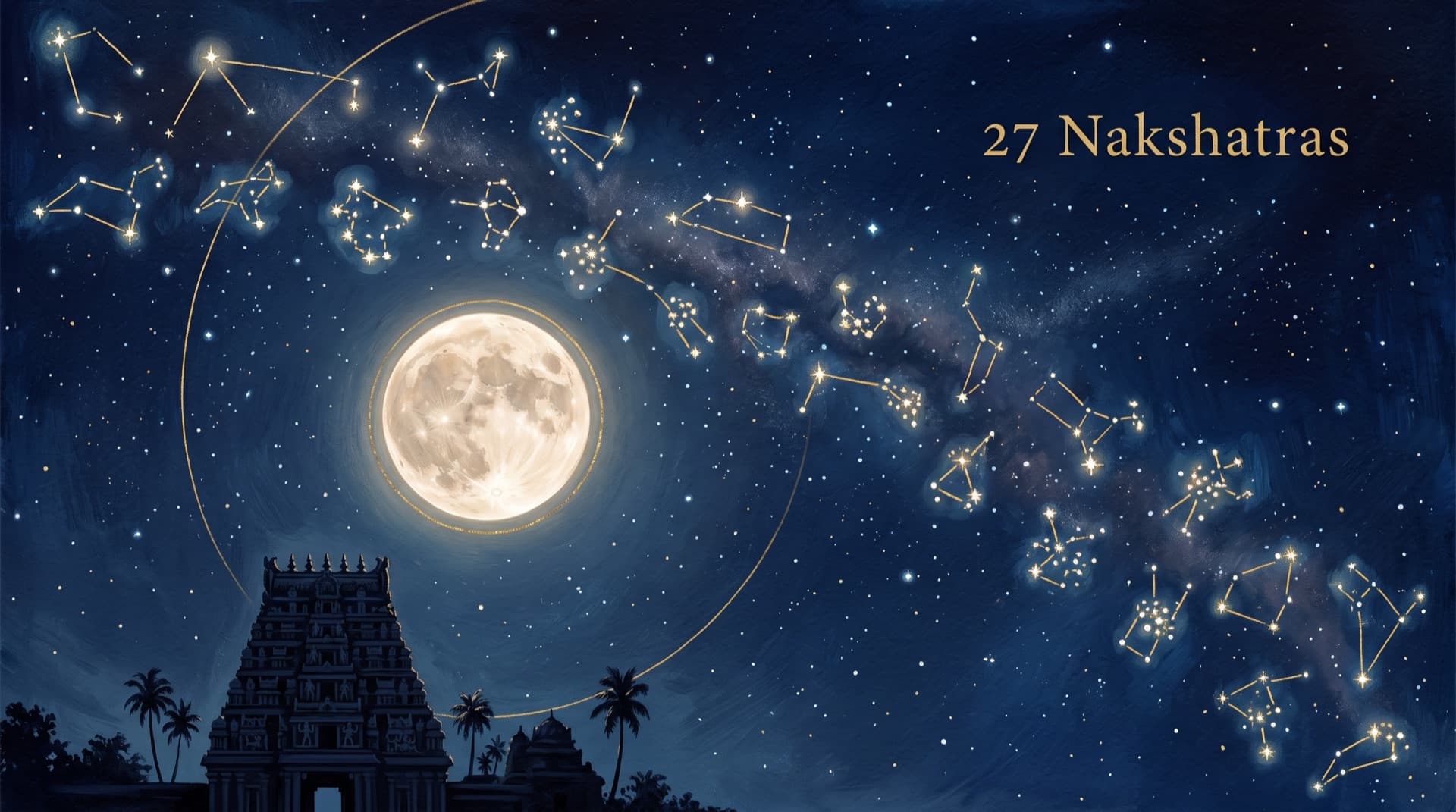
The 27 Nakshatras: Lunar Mansions, Gana Types, and Matching in Jyotish
Discover the 27 Nakshatras of Vedic Astrology. Learn how lunar constellations, Padas, Gana types, and ruling grahas shape personality, Dasha timing, and Kundli matching.
In short: The 27 Nakshatras are 13°20′ lunar sectors used in Vedic astrology to describe the Moon’s position, temperament and timing. Each nakshatra has four padas, a ruling graha and a symbolic pattern; these features are used in dasha analysis, muhurta and Kundli matching.
Key points:
- The Moon’s nakshatra at birth is called the Janma Nakshatra and helps determine the starting Vimshottari dasha.
- Gana, yoni, nadi and other matching factors are interpreted together, not as a single pass/fail score.
- A precise birth time and place improve the reliability of the nakshatra and pada calculation.
While zodiac signs (Rashis) divide the 360-degree sky into 12 broad 30-degree segments, Vedic Astrology (Jyotish) utilizes a much higher resolution celestial grid: the 27 Nakshatras (lunar constellations or lunar mansions).
The word Nakshatra is derived from Naksha (map) and Tara (star). Because the Moon takes approximately 27.3 days to orbit the Earth, it spends roughly one day traversing each of these 27 stellar zones.
The Structure of a Nakshatra: Degrees and Padas
Each of the 27 Nakshatras spans exactly 13 degrees and 20 minutes of the zodiac arc (360° ÷ 27 = 13° 20').
Furthermore, every Nakshatra is divided into 4 quarters called Padas (each measuring 3 degrees and 20 minutes):
1 Nakshatra = 4 Padas9 Padas = 1 Rashi (Zodiac Sign = 30°)108 Total Padas = Entire Zodiac (360°)
The 108 Nakshatra Padas correspond directly to the 108 beads on a traditional sacred Japa Mala, mapping cosmic acoustic frequencies to spiritual practice.
The Complete Roster of 27 Nakshatras
Each Nakshatra is governed by a specific Ruling Planet (Graha), a Presiding Deity, and a Symbolic Emblem:
| # | Nakshatra Name | Span (Sign Degrees) | Ruling Graha | Presiding Deity | Symbolic Emblem |
|---|---|---|---|---|---|
| 1 | Ashwini | 0°00' - 13°20' Aries | Ketu | Ashwini Kumaras | Horse's Head |
| 2 | Bharani | 13°20' - 26°40' Aries | Venus | Yama (God of Dharma) | Yoni / Vessel |
| 3 | Krittika | 26°40' Aries - 10°00' Taurus | Sun | Agni (God of Fire) | Razor / Flame |
| 4 | Rohini | 10°00' - 23°20' Taurus | Moon | Brahma (The Creator) | Chariot / Ox Cart |
| 5 | Mrigashira | 23°20' Tau - 6°40' Gem | Mars | Soma (Moon God) | Deer's Head |
| 6 | Ardra | 6°40' - 20°00' Gemini | Rahu | Rudra (Storm Shiva) | Teardrop / Diamond |
| 7 | Punarvasu | 20°00' Gem - 3°20' Can | Jupiter | Aditi (Cosmic Mother) | Bow & Quiver |
| 8 | Pushya | 3°20' - 16°40' Cancer | Saturn | Brihaspati (Guru) | Cow's Udder / Lotus |
| 9 | Ashlesha | 16°40' - 30°00' Cancer | Mercury | Nagas (Serpent Deities) | Coiled Serpent |
| 10 | Magha | 0°00' - 13°20' Leo | Ketu | Pitrus (Ancestors) | Royal Throne |
| 11 | Purva Phalguni | 13°20' - 26°40' Leo | Venus | Bhaga (God of Fortune) | Hammock / Couch |
| 12 | Uttara Phalguni | 26°40' Leo - 10°00' Vir | Sun | Aryaman (Patronage) | Bed Posts |
| 13 | Hasta | 10°00' - 23°20' Virgo | Moon | Savitar (Sun Deity) | Open Hand / Fist |
| 14 | Chitra | 23°20' Vir - 6°40' Lib | Mars | Vishwakarma (Architect) | Bright Gem / Pearl |
| 15 | Swati | 6°40' - 20°00' Libra | Rahu | Vayu (God of Wind) | Young Sprout / Coral |
| 16 | Vishakha | 20°00' Lib - 3°20' Sco | Jupiter | Indra & Agni | Triumphal Arch |
| 17 | Anuradha | 3°20' - 16°40' Scorpio | Saturn | Mitra (God of Friendship) | Lotus Flower |
| 18 | Jyeshta | 16°40' - 30°00' Scorpio | Mercury | Indra (King of Deities) | Round Talisman / Earring |
| 19 | Mula | 0°00' - 13°20' Sag | Ketu | Nirriti (Goddess of Roots) | Tied Bunch of Roots |
| 20 | Purva Ashadha | 13°20' - 26°40' Sag | Venus | Apas (Water Deities) | Elephant's Tusk / Fan |
| 21 | Uttara Ashadha | 26°40' Sag - 10°00' Cap | Sun | Vishvedevas (Universal) | Elephant Tusk / Small Bed |
| 22 | Shravana | 10°00' - 23°20' Cap | Moon | Vishnu (The Preserver) | Three Footprints / Ear |
| 23 | Dhanishta | 23°20' Cap - 6°40' Aqu | Mars | Eight Vasus (Abundance) | Drum / Flute |
| 24 | Shatabhisha | 6°40' - 20°00' Aquarius | Rahu | Varuna (Cosmic Ocean) | Empty Circle / 100 Healers |
| 25 | Purva Bhadrapada | 20°00' Aqu - 3°20' Pis | Jupiter | Aja Ekapada | Front of Funeral Cot |
| 26 | Uttara Bhadrapada | 3°20' - 16°40' Pisces | Saturn | Ahirbudhnya (Deep Serpent) | Back of Funeral Cot |
| 27 | Revati | 16°40' - 30°00' Pisces | Mercury | Pushan (Protector of Travelers) | Fish / Pair of Drumsticks |
What Your Nakshatra's Ruling Graha Colors
Each Nakshatra's ruling planet is also the planet whose Mahadasha you are born into, and its character tends to run through the rest of the Nakshatra's themes:
- Ketu-ruled (Ashwini, Magha, Mula): a restless, detached, instinct-first energy, often drawn to healing, research, or the unconventional.
- Venus-ruled (Bharani, Purva Phalguni, Purva Ashadha): themes of creativity, relationship, and sensory pleasure, with a strong pull toward beauty and comfort.
- Sun-ruled (Krittika, Uttara Phalguni, Uttara Ashadha): a drive for recognition, leadership, and purification through effort.
- Moon-ruled (Rohini, Hasta, Shravana): nurturing, receptive, and deeply tied to emotional and material security.
- Mars-ruled (Mrigashira, Chitra, Dhanishta): action-oriented, competitive, quick to pursue what it wants.
- Rahu-ruled (Ardra, Swati, Shatabhisha): unconventional, questioning, drawn to disruption and reinvention.
- Jupiter-ruled (Punarvasu, Vishakha, Purva Bhadrapada): expansive, principled, oriented toward growth and meaning.
- Saturn-ruled (Pushya, Anuradha, Uttara Bhadrapada): disciplined, patient, comfortable with duty and delayed reward.
- Mercury-ruled (Ashlesha, Jyeshta, Revati): analytical, communicative, adaptable, often skilled with detail.
This is a broad lens, not a checklist. The Nakshatra lord's actual strength, house placement, and aspects in a specific chart decide how strongly these themes show up.
Why Your Birth Nakshatra Shapes Your Entire Life
Janma Nakshatra (Birth Constellation): The Nakshatra occupied by your Moon at the exact moment of birth is your Janma Nakshatra. It determines your instinctive emotional temperament, psychological archetypes, and subconscious motivations.
Dasha Sequence Trigger: The ruling planet of your Janma Nakshatra determines which Vimshottari Mahadasha you are born into! For example, being born with Moon in Pushya Nakshatra starts your life in a Saturn Mahadasha.
Nakshatra Compatibility (Tara Bala): In Kundli matching and Muhurta, the energetic distance between your Janma Nakshatra and a day's transit Nakshatra indicates whether that day brings smooth fortune (Sadhaka), wealth (Mitra), or demands caution (Vipat).
The Three Gana Types: Deva, Manushya, and Rakshasa
Classical Jyotish sorts all 27 Nakshatras into three Gana (temperament) groups. This is one of the eight factors (Kootas) checked in traditional Kundli matching, and it broadly indicates disposition rather than destiny:
- Deva Gana (Divine): Ashwini, Mrigashira, Punarvasu, Pushya, Hasta, Swati, Anuradha, Shravana, Revati. Associated with a gentle, accommodating, idealistic temperament.
- Manushya Gana (Human): Bharani, Rohini, Ardra, Purva Phalguni, Uttara Phalguni, Purva Ashadha, Uttara Ashadha, Purva Bhadrapada, Uttara Bhadrapada. Associated with a balanced, ambition-driven, pragmatic temperament.
- Rakshasa Gana (Fierce): Krittika, Ashlesha, Magha, Chitra, Vishakha, Jyeshta, Mula, Dhanishta, Shatabhisha. Associated with an intense, independent, strong-willed temperament.
A Gana label is a broad behavioural tendency read alongside the rest of the chart, not a verdict on someone's character. Two people sharing a Rakshasa Gana Nakshatra can express that intensity very differently depending on their Lagna, Moon strength, and the planets aspecting that Nakshatra.
Nakshatra vs Rashi: Two Different Grids on the Same Sky
Beginners often use "Moon sign" and "birth star" interchangeably, but they answer different questions:
- Rashi (zodiac sign) is a 30-degree slice of the sky. It tells you the broad archetype your Moon (or Lagna, or any graha) falls under, one of 12 possibilities.
- Nakshatra is a 13°20' slice, roughly a third the width of a Rashi. It tells you which of the 27 stellar zones your Moon occupies, giving Jyotish a far finer resolution than the Rashi alone.
Two people can share the same Moon Rashi yet have completely different Janma Nakshatras (and therefore different ruling grahas and Dasha sequences), because a single Rashi spans between two and three Nakshatras. This is why a serious Kundli reading always states both: the Rashi for the broad picture, and the Nakshatra and Pada for the finer one.
Nakshatras in Kundli Matching
Nakshatra compatibility is one of the eight Kootas weighed in Guna Milan (Ashtakoota matching) for marriage compatibility, alongside factors like Gana, Nadi, and Bhakoot. The bride and groom's Janma Nakshatras are compared for compatibility of temperament, health lineage, and general harmony, and the Gana groups above form part of that comparison.
This article focuses on what a Nakshatra is and means on its own. For the full eight-factor matching methodology and how points are scored, see Guna Milan Basics.
Practical Uses: Naming and Muhurta
Two everyday applications of Nakshatra knowledge in Indian households:
- Naming conventions: Each Nakshatra Pada is traditionally associated with a starting syllable, which is why many families choose a newborn's first name based on the Pada active at birth.
- Muhurta (auspicious timing): Certain Nakshatras are traditionally considered favourable for specific undertakings, such as travel, a Griha Pravesh, or starting a new venture, while others call for more caution. See Shubh Muhurat Importance for how Nakshatra fits into broader Muhurta selection.
Finding Your Own Birth Nakshatra
Your Janma Nakshatra is set by the Moon's position at your exact birth time, not the Sun's, which is why it differs from the "sun sign" most horoscope columns use. Because the Moon moves roughly 13 degrees a day, an accurate birth time and place matter more here than almost anywhere else in the chart; a birth time off by even an hour can shift you into a neighbouring Pada, or occasionally a neighbouring Nakshatra altogether.
Used well, your Nakshatra adds real texture to a reading: it refines the Dasha sequence, sharpens Muhurta choices, and feeds into matching. Used carelessly, it becomes another label to overinterpret. Treat it as one input among many in a full Kundli, not a standalone verdict.
Generate your free Kundli to see your exact Janma Nakshatra, Pada, and the Dasha it starts you in.
Have questions about your own Kundli?
Talk or chat directly with GyaaniJyotish AI in 10 Indian languages. Get accurate insights grounded in your date, time, and place of birth.
Related Vedic Guides
Vedic Astrology & Dashas
Kaal Sarp Dosha: Meaning, the 12 Types & Authentic Remedies
A classically grounded, non-fear-based guide to Kaal Sarp Dosha. Learn how it forms, its 12 traditional types, cancellation factors, and authentic remedies.
Read articleVedic Astrology & Dashas
Live Astrologer Sessions on GyaaniJyotish: How AI Jyotishi Chat and Voice Consultations Work
What a 'live astrologer' session actually means on GyaaniJyotish, how chat and voice consultations with an AI Jyotishi work, which languages are supported, and what to expect from a session.
Read articleDivisional Charts (D-Charts)
D60 Shastiamsha Chart: Past Life Karma, Micro-Destiny & Root Cause Analysis
Master the D60 Shastiamsha chart in Vedic Astrology. Learn why Maharishi Parashara rated D60 supreme for evaluating past life karma, twin charts, and root destiny.
Read article