What Is a Kundli, and How Do You Read One? The Complete Guide
A Janma Kundli is a precise map of the cosmos at your moment of birth. Learn what Lagna, Bhavas, Grahas, and Dashas mean, then follow a step-by-step method to read your own birth chart.
In short: A Janma Kundli is a Vedic birth chart calculated from the exact date, time and place of birth. To read it, start with the Lagna and its lord, then examine houses, signs, planets, aspects, divisional charts and dashas together rather than relying on a single placement.
Key points:
- The Lagna describes the chart’s starting point; Bhavas show life areas and Grahas show planetary significations.
- Birth time matters because a small error can change the ascendant, house cusps and dasha balance.
- A chart describes traditional tendencies and timing; it should not be presented as a certainty or as medical, legal or financial advice.
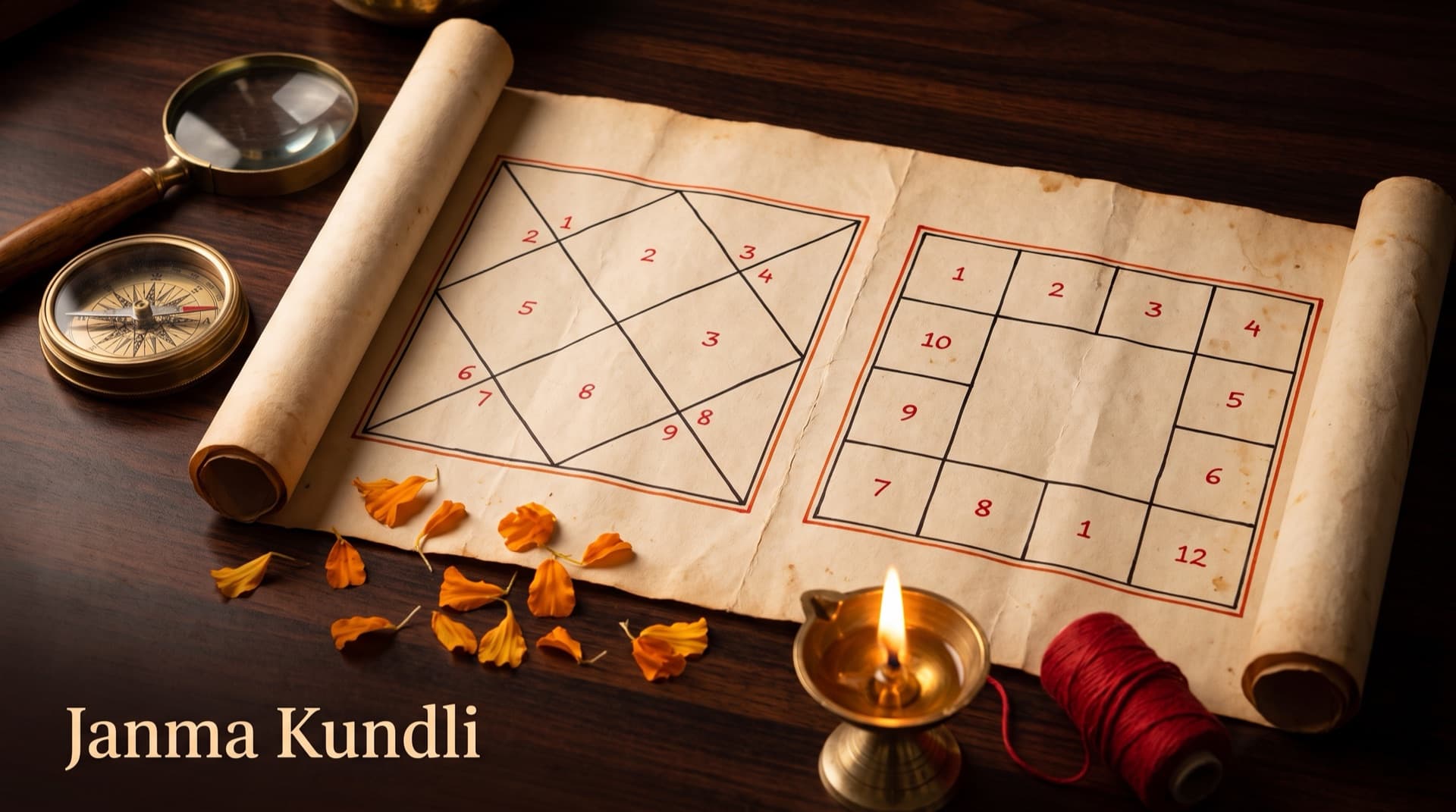
A Janma Kundli (also known as a Vedic birth chart or natal horoscope) is an exact astronomical diagram of the planetary sky captured at the precise moment and geographic location of your birth. In classical Jyotish ("the science of light"), a Kundli is far more than a personality archetype or solar sign summary. It is treated as a structural blueprint of your karma, innate tendencies, potential challenges, and cosmic timing.
This guide covers both halves of that idea: what each part of the chart means, and the order in which an astrologer actually reads them. Once you know the four building blocks, reading your own Kundli becomes a repeatable six-step process rather than a wall of unfamiliar symbols.
The Four Core Pillars of a Janma Kundli
To read a Vedic birth chart accurately, an astrologer evaluates four fundamental layers that interact dynamically:
1. The Lagna (Ascendant)
The Lagna is the zodiac sign that was rising on the eastern horizon at the exact minute of your birth.
- Why it shifts quickly: Because Earth completes a 360-degree rotation on its axis every 24 hours, the Lagna changes roughly every two hours.
- Significance: The Lagna sets the entire house structure for your chart. It determines which sign occupies the 1st house (Self), 2nd house (Wealth), 5th house (Mind & Children), 7th house (Partnership), and 10th house (Career).
- Lagna Lord: The ruling planet of your Lagna is your primary life chart lord (Ascendant Lord). Its placement and strength indicate your overall physical vitality, orientation in life, and personal agency.
2. The Twelve Bhavas (Houses)
A Kundli is divided into 12 houses (Bhavas), each representing specific domains of human life:
| House | Sanskrit Name | Core Domains Governed |
|---|---|---|
| 1st House | Tanu Bhava | Physical body, health, appearance, character, overall destiny |
| 2nd House | Dhana Bhava | Accumulated wealth, family, speech, food habits, right eye |
| 3rd House | Bhratri Bhava | Siblings, courage, self-effort, short journeys, communication |
| 4th House | Sukha Bhava | Mother, home environment, vehicles, mental peace, real estate |
| 5th House | Putra Bhava | Intelligence, higher education, progeny, past-life merit (Purva Punya) |
| 6th House | Shatru Bhava | Health challenges, debts, daily work, competitive endeavors, obstacles |
| 7th House | Yuvati Bhava | Marriage, life partner, business alliances, commercial trade |
| 8th House | Randhra Bhava | Longevity, sudden changes, hidden wealth, research, transformation |
| 9th House | Dharma Bhava | Higher wisdom, guru, father, righteousness, long journeys, luck |
| 10th House | Karma Bhava | Career, public reputation, authority, profession, achievements |
| 11th House | Labha Bhava | Income, gains, social network, fulfillment of desires, elder siblings |
| 12th House | Vyaya Bhava | Expenses, spiritual liberation (Moksha), foreign travels, isolation |
3. The Nine Grahas (Planetary Forces)
Vedic astrology tracks the positions and interactions of nine key celestial bodies (Navagrahas):
- Surya (Sun): Soul, ego, father, authority, vitality
- Chandra (Moon): Mind, emotions, mother, instinct, mental harmony
- Mangal (Mars): Energy, courage, passion, siblings, physical strength
- Budha (Mercury): Intellect, logic, speech, trade, analytical skills
- Guru (Jupiter): Wisdom, fortune, spiritual alignment, wealth, mentorship
- Shukra (Venus): Art, relationships, romance, comfort, aesthetic beauty
- Shani (Saturn): Discipline, responsibility, career perseverance, longevity
- Rahu (North Node): Ambition, innovation, worldly desire, illusion
- Ketu (South Node): Detachment, spiritual insight, past karma, intuition
4. Divisional Charts (Vargas)
In addition to the primary birth chart (Rashi Chart or D1), Vedic astrology utilizes 16 micro-divisional charts called Vargas. The most important of these is the Navamsha Chart (D9), which acts as the "chart of the soul." While the D1 chart shows the seed of potential, the D9 chart shows whether that seed will blossom into fruition in the second half of life and in marriage.
Why Exact Birth Time is Crucial in Vedic Astrology
In Western astrology, birth dates alone are often used to assign a Sun sign. In Vedic Jyotish, an exact birth time (down to the minute) is critical for several technical reasons:
- Lagna Cusp Shifts: A difference of just 5 to 10 minutes can shift the Lagna sign or move the Ascendant degree across house boundaries, completely altering the house lords.
- Navamsha (D9) Precision: A D9 divisional chart changes sign every 13 to 15 minutes. An inaccurate time leads to reading the wrong soul chart.
- Vimshottari Dasha Balance: The starting planetary period (Mahadasha) at birth is calculated based on the Moon's exact longitude down to degrees, minutes, and arcseconds. A 15-minute birth time error can shift your life timeline by several years!
How to Read Your Kundli: A Six-Step Walkthrough
Once your chart is generated, an astrologer does not scan it randomly. Classical texts describe a fairly consistent order of analysis, moving from the broad structure down to the timing of specific events. You can follow the same sequence on your own chart.
Step 1: Find Your Lagna and Treat It as the Anchor
Every reading starts at the Lagna, because it fixes which sign sits in which house for the rest of the chart. Two people born the same day, even the same hour, can have different Lagnas and therefore almost unrelated charts. Before looking at anything else, note your Lagna sign and its ruling planet (the Lagna Lord), since its strength is read as a proxy for your general vitality and direction in life.
Step 2: Scan the Twelve Houses at a Glance
With the Lagna fixed, look at which houses are Kendra (1st, 4th, 7th, 10th: the pillars that hold the chart's structure), which are Trikona (1st, 5th, 9th: the fortune-and-merit houses), and which are Dusthana (6th, 8th, 12th: the houses of obstacle, crisis, and loss). A chart with strong planets in Kendra and Trikona houses is generally read as more supportive than one where the same planets sit in Dusthana houses. This is only an orientation pass; for the full house-by-house breakdown, see the complete guide to the 12 Bhavas.
Step 3: Check Each Planet's Placement and Strength
For every graha, note two things: which house it occupies, and how strong it is in its sign. A planet is exalted (Uchcha) in one specific sign, debilitated (Neecha) in the opposite sign, and considered comfortable in its own sign or a friend's sign. A planet sitting within a few degrees of the Sun is called combust (Asta), which classical texts treat as weakening its clear expression. This single pass (house plus strength, for all nine grahas) tells you more about a chart than any individual placement read in isolation.
Step 4: Spot the Major Yogas
Certain planetary combinations are named and studied on their own, because classical texts assign them a distinct, amplified effect beyond what the individual placements would suggest. Gajakesari Yoga, the Pancha Mahapurusha yogas, and various Raja and Dhana yogas are the ones read for most often. Identifying them requires checking specific house and sign relationships between planets, so this step is worth a dedicated pass. See the guide to auspicious yogas in a Kundli for how each one is formed.
Step 5: Read the Chart Against the Current Dasha
A Kundli describes potential; the Vimshottari Dasha system describes when that potential is likely to become active. The same 10th house strength that looks unused in your twenties can be exactly what the chart was pointing to once its ruling planet's Mahadasha begins. Skipping this step is the single most common reason a static chart reading feels disconnected from someone's actual life. See how Dasha periods work for the full mechanics.
Step 6: Know When to Open a Divisional Chart
The main birth chart (D1, or Rashi chart) is a general-purpose map. For a specific question, classical Jyotish turns to one of the Vargas (divisional charts) built for that exact domain: the Navamsha (D9) for marriage and the second half of life, or the Dasamsa (D10) for career and profession. A placement that looks weak in the D1 can look considerably stronger once you check the relevant Varga, and vice versa.
Putting the Six Steps Together: A Worked Example
To see how the sequence fits together, walk through a hypothetical chart. Say the Lagna is Cancer, so the Lagna Lord is the Moon (Step 1). Scanning the houses (Step 2), the 10th house (career, a Kendra) is Aries, meaning its lord is Mars.
Next, check where Mars actually sits (Step 3). If Mars is placed in the 5th house in its own sign, that is a reasonably strong placement: an own-sign planet ruling a Kendra house, sitting in a Trikona house, is generally read as favourable for career-related effort and recognition. If instead Mars were debilitated in the 4th house, the same 10th-house rulership would carry a very different weight, and any reading would need to account for that weakness rather than assume the house is automatically strong.
Suppose this Mars-in-5th placement also forms a recognised combination with Jupiter (Step 4), such as a Dhana Yoga tied to income. On paper, this looks encouraging. But the chart alone does not say when. Checking the Dasha sequence (Step 5), this yoga's effects would be read as most active during Mars's own Mahadasha or Antardasha, not necessarily at the present age. If someone is currently running a Saturn period instead, the classical expectation is that Saturn's themes (discipline, delay, restructuring) will dominate day-to-day experience, even with a strong Mars yoga sitting quietly in the background waiting for its period to arrive.
Finally, for a career-specific question, the D10 Dasamsa chart (Step 6) is checked to see whether this same strength repeats or shifts in the divisional chart built specifically for profession. A consistent signal across the D1 and D10 is read as more reliable than a signal that only appears in one of the two.
This is the mechanism behind most Vedic astrology readings: identify the raw placements, weigh their strength, note any named yogas, then layer in Dasha timing and the relevant divisional chart before drawing a conclusion. Skipping any one of these layers is usually what makes a reading feel oversimplified or inconsistent with lived experience.
Common Mistakes Beginners Make
- Reading one placement in isolation. "Mars in the 7th house" means little on its own; it has to be weighed against the house lord, aspects from other planets, and the Dasha in effect.
- Ignoring Dasha timing entirely. A chart is not a fixed prediction read the same way at every age. The same placement expresses differently depending on which planet's period is currently running.
- Applying Western sun-sign logic to a Vedic chart. Vedic astrology uses the sidereal zodiac (adjusted for the slow precession of the equinoxes), so your Vedic Moon sign or Lagna will often differ from your Western Sun sign. They are not interchangeable systems.
- Treating a single Dosha as a verdict. Classical texts also describe cancellation conditions (Bhanga) for most doshas. A dosha noted in isolation, without checking whether it is cancelled, tells an incomplete story.
A Short Glossary of Core Terms
| Term | Meaning |
|---|---|
| Lagna | The Ascendant; the sign rising on the horizon at birth |
| Bhava | A house; one of 12 divisions of life the chart is organised into |
| Graha | A planet or lunar node tracked in Vedic astrology (nine in total) |
| Rashi | A zodiac sign; also refers to the main D1 birth chart |
| Dasha | A planetary period system used to time when a placement becomes active |
| Yoga | A specific, named planetary combination with its own classical effect |
| Dosha | An affliction or imbalance indicated by a planetary placement |
How GyaaniJyotish Handles Uncertain Birth Times
Many individuals do not have a birth certificate recorded to the exact minute. GyaaniJyotish provides calm, transparent guidance when birth times are approximate:
- It highlights when an astrological pattern is robust across a time window (e.g., planetary signs) versus when it depends on an exact minute (e.g., fast-changing Lagna or divisional chart).
- It offers Birth Time Rectification principles to verify historical events (marriage, career pivots, child birth) against dasha timelines.
Understanding your Kundli gives you self-awareness and practical clarity, empowering you to navigate life with conscious purpose rather than passive expectation.
The fastest way to put this six-step method into practice is on your own chart. Generate your free Kundli and work through the Lagna, houses, planetary strengths, and current Dasha as you read.
Have questions about your own Kundli?
Talk or chat directly with GyaaniJyotish AI in 10 Indian languages. Get accurate insights grounded in your date, time, and place of birth.
Related Vedic Guides
Kundli & Birth Charts
Child Astrology: A Parent's Guide to Reading a Kundli Responsibly
How Vedic astrology has traditionally been used around a child's early years, from Naamkaran to schooling muhurats, and why a Kundli is a lens for reflection, not a verdict on your child's future.
Read articleDivisional Charts (D-Charts)
D60 Shastiamsha Chart: Past Life Karma, Micro-Destiny & Root Cause Analysis
Master the D60 Shastiamsha chart in Vedic Astrology. Learn why Maharishi Parashara rated D60 supreme for evaluating past life karma, twin charts, and root destiny.
Read articleDivisional Charts (D-Charts)
D9 Navamsha Chart: The Soul Blueprint, Marriage & True Planetary Strength
Master the D9 Navamsha chart in Vedic Astrology. Learn why D9 is called the chart of the soul, predicting spouse traits, marriage timing, and Vargottama planets.
Read article