Yogas in Vedic Astrology: Raja Yoga, Gajakesari & Pancha Mahapurusha
A complete guide to the major Yogas in Vedic Astrology: Raja Yoga, Gajakesari, Budhaditya, Pancha Mahapurusha, Neechabhanga, Viparita Raja Yoga and Kemadruma Dosha.
In short: Yogas are named combinations of planets, signs and houses in a Vedic birth chart that are traditionally interpreted as themes or potentials. Raja Yoga, Gajakesari, Budhaditya, Pancha Mahapurusha, Neechabhanga and Viparita Raja Yoga must be judged by strength, dignity, cancellation, timing and the rest of the Kundli—not by a label alone.
Key points:
- Gajakesari Yoga is traditionally formed when Jupiter is in a Kendra from the Moon, with strength and context affecting its results.
- Pancha Mahapurusha Yogas arise from a strong Mars, Mercury, Jupiter, Venus or Saturn in a Kendra in its own or exaltation sign.
- A yoga is a potential pattern; dashas and transits indicate when its themes may become more visible.
In Vedic Astrology (Jyotish), the word Yoga means "union" or "combination." A Yoga occurs when specific planets, house lords, or zodiac signs form defined geometric relationships in a birth chart, unlocking particular talents, fame, leadership, wealth, or spiritual wisdom.
While thousands of Yogas are catalogued in classical texts like Brihat Parashara Hora Shastra and Saravali, a handful of foundational Yogas come up again and again in a working chart reading. This guide walks through them, along with the honest caveats that classical Jyotish itself attaches to them.
What "Yoga" Means Here (It Is Not the Asana Practice)
Newcomers often assume a "Yoga" in astrology refers to the physical postures taught in a Yoga class. It does not. In Jyotish, a Yoga is a structural condition in the chart: a specific planet sitting in a specific house, two planets sharing dignity, or two house lords connecting to each other. The word simply means "combination" or "union," in the sense of planets and houses uniting to produce a describable effect.
Every classical Yoga has three parts worth checking before treating it as significant:
- Formation: which planets and houses must be involved, and how (conjunction, mutual aspect, sign exchange).
- Dignity: whether the participating planets are strong (own sign, exalted) or weak (debilitated, combust), since this changes the intensity of the result.
- Timing: when the Yoga actually delivers, which is governed separately by Dasha and transit (more on this below).
1. Raja Yogas (Combinations for Authority & Success)
A Raja Yoga (literally "Royal Combination") forms when there is a close relationship between a Kendra Lord (Pillar of Action: 1st, 4th, 7th, 10th) and a Trikona Lord (Pillar of Fortune: 1st, 5th, 9th).
How Raja Yogas Form
- A Kendra lord and Trikona lord occupy the same house (conjunction).
- A Kendra lord and Trikona lord aspect each other directly across the chart.
- A Kendra lord and Trikona lord exchange signs (Parivartana Yoga).
Impact: During the Vimshottari Dasha of the participating planets, the person tends to experience professional elevation, public recognition, authority, and financial stability.
Raja Yoga is treated as a category rather than a single fixed combination. A chart can carry several Raja Yogas of varying strength, and Jyotish considers the one involving the strongest, least afflicted planets to be the one most likely to show up clearly in a person's life.
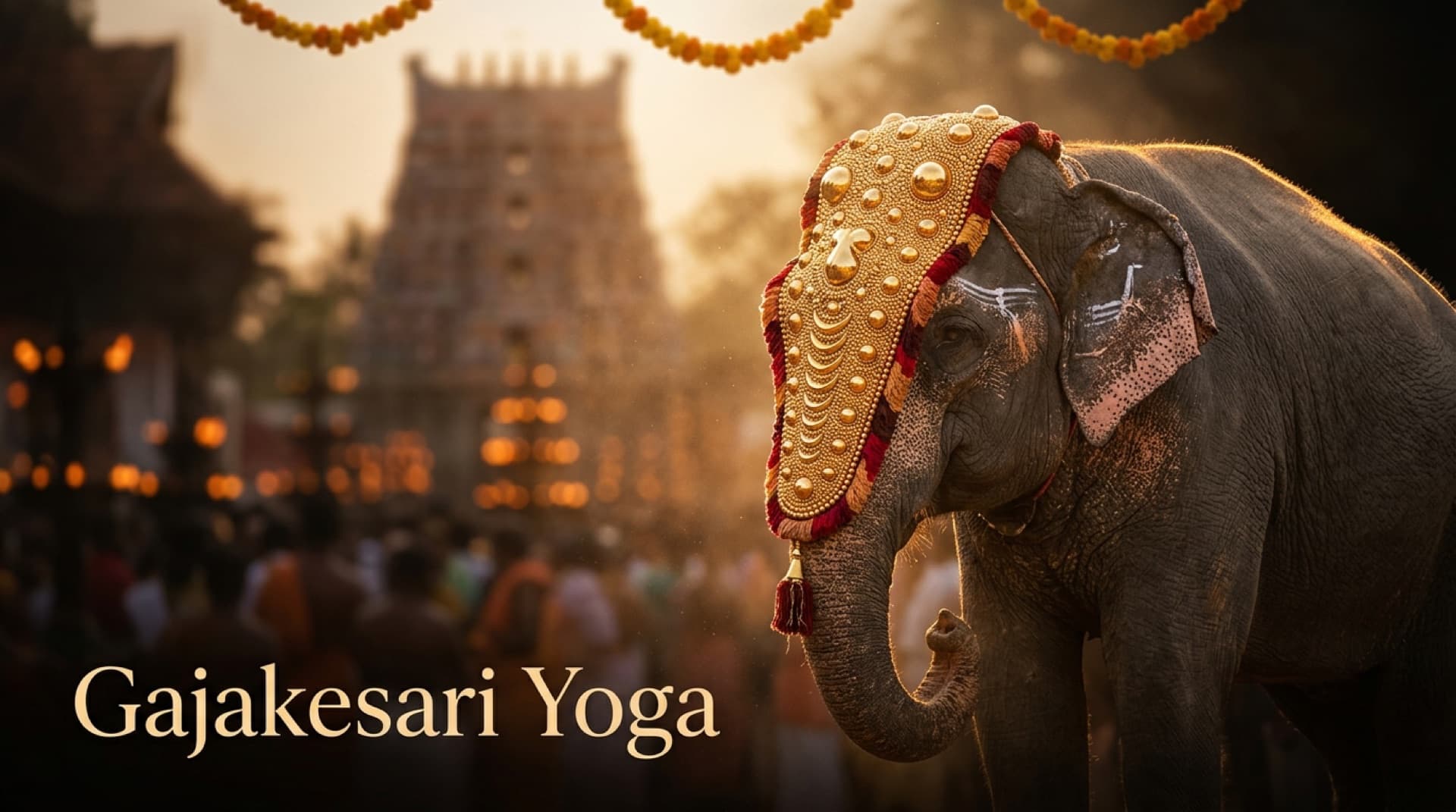
2. Gajakesari Yoga (The Lion-Elephant Combination)
Gajakesari Yoga is one of the most widely referenced Yogas for intelligence, lasting reputation, and protective fortune.
- Formation: Formed when Jupiter (Guru) occupies a Kendra house (1st, 4th, 7th, or 10th) from the Moon (Chandra).
- Symbolism: Gaja (elephant, majestic strength and wisdom) plus Kesari (lion, unshakeable courage and dignity).
- Core Results: Sharp intellect, a respected public standing, noble character, financial stability, and long-term wisdom. Classical texts associate this Yoga with overcoming adversaries through poise rather than confrontation.
3. Budhaditya Yoga (The Sun-Mercury Combination)
Formed when Sun (Surya) and Mercury (Budha) sit together in the same house.
- Symbolism: Sun (soul and authority) combined with Mercury (intellect and communication).
- Core Results: Classical texts link this Yoga to strong analytical ability, articulate speech, academic aptitude, and suitability for administration, law, accounting, management, or technology work.
- Dignity Rule: Budhaditya Yoga is considered strongest when formed in a sign where both planets are comfortable (such as Leo or Virgo), and without heavy affliction from Rahu or Saturn.
4. The Pancha Mahapurusha Yogas (Five Great Human Combinations)
Formed when one of five non-luminary planets (Mars, Mercury, Jupiter, Venus, Saturn) occupies a Kendra house (1, 4, 7, 10) in its own sign or exaltation sign:
Mars ──> Ruchaka Yoga | Mercury ──> Bhadra Yoga | Jupiter ──> Hamsa Yoga
           Venus ──> Malavya Yoga | Saturn ──> Sasa Yoga
| Yoga Name | Planet Required | Placement Condition | Key Life Traits & Destiny |
|---|---|---|---|
| Ruchaka Yoga | Mars (Mangal) | Kendra in Aries, Scorpio, or Capricorn | Courage, physical stamina, athletic or leadership drive, decisive action |
| Bhadra Yoga | Mercury (Budha) | Kendra in Gemini or Virgo | Intellectual sharpness, articulate speech, commercial aptitude, scholarly interests |
| Hamsa Yoga | Jupiter (Guru) | Kendra in Sagittarius, Pisces, or Cancer | Wisdom, ethical grounding, a respected mentor figure, calm leadership |
| Malavya Yoga | Venus (Shukra) | Kendra in Taurus, Libra, or Pisces | Artistic sensibility, charm, comfort, harmonious relationships, aesthetic taste |
| Sasa Yoga | Saturn (Shani) | Kendra in Capricorn, Aquarius, or Libra | Discipline, organisational ability, stamina, authority earned through persistence |
A chart can technically carry more than one Pancha Mahapurusha Yoga at once, since five different planets are being checked against the same four Kendra houses. When two of these Yogas form together, classical commentators generally read them as reinforcing each other rather than competing, provided both participating planets are reasonably free of affliction from Rahu, Ketu, or a debilitated placement elsewhere in the chart.
It is also worth noting what these Yogas are not. They describe a planet's placement strength, not a promise of fame or riches by themselves. A Ruchaka Yoga, for instance, points to physical courage and decisive action as inherent traits; whether that translates into an athletic career, a business turnaround, or simply a resilient temperament depends on the rest of the chart and the life circumstances the person is born into.
Two More Combinations Worth Knowing
Beyond the five discussed above, two further classical combinations come up often enough in chart readings to be worth a brief mention:
- Adhi Yoga forms when benefic planets (commonly Mercury, Venus, and Jupiter) occupy the 6th, 7th, and 8th houses from the Moon, either individually or in combination. Classical texts associate it with sustained good fortune and an ability to overcome opposition gracefully, since benefics are, unusually, supporting the Moon from houses that are otherwise considered difficult.
- Saraswati Yoga forms when Jupiter, Venus, and Mercury are together strong, whether through conjunction, mutual aspect, or occupying Kendra and Trikona houses from the Lagna, generally in their own or exalted signs. It is named after the goddess of learning and is associated with scholarship, eloquence, and creative or artistic ability.
Both illustrate a recurring theme in Yoga analysis: it is rarely a single planet acting alone. Most classical Yogas describe a relationship between two or more planets or houses, which is exactly why isolated, single-factor readings (a friend telling you "you have Gajakesari Yoga" without checking dignity or Dasha) tend to be unreliable on their own.
Dhana Yoga: When the Chart Favours Wealth
Dhana Yoga is not one combination but a family of them, built around connections between wealth-related houses, chiefly the 2nd (accumulated wealth), 11th (gains and income), and their lords, often working alongside a Kendra or Trikona lord. Because this topic has enough nuance to fill its own guide, from house-lord combinations to the role of Jupiter and Venus, read the dedicated breakdown in Dhana Yogas and wealth indicators rather than a summary here.
Neechabhanga Raja Yoga: When a Weakness Becomes a Strength
A planet in its debilitation sign (Neecha) is usually read as a weak placement. Neechabhanga Raja Yoga describes a specific classical exception: when certain conditions cancel that debilitation and, in some readings, convert it into a source of authority instead.
The cancellation typically requires one of these, depending on the classical rule applied:
- The lord of the debilitated planet's sign is placed in a Kendra from the Lagna or the Moon.
- The planet that would be exalted in the debilitated planet's sign is itself placed in a Kendra.
- The planet debilitated in the birth chart is exalted in the Navamsha (D9) chart.
The classical logic is that a planet struggling in one placement can still rise if the chart offers it structural support elsewhere. This is one of the more debated areas of Jyotish, and different classical texts apply slightly different tests, so it is best read alongside a full chart rather than checked in isolation.
Viparita Raja Yoga: Strength Born from Difficulty
The Dusthana houses (6th, 8th, and 12th) govern conflict, disruption, and loss. Viparita Raja Yoga forms when the lords of these three houses are placed in each other's houses, essentially trading difficult territory among themselves rather than spilling into the rest of the chart.
Classical Jyotish reads this as containment: the affliction that would normally spread gets locked inside the Dusthana houses, and the person is often described as gaining resilience, or an unexpected turnaround, particularly after a period of hardship. It is a good example of how Jyotish treats difficult houses as complex rather than uniformly negative.
Chandra-Mangal Yoga
Formed when the Moon (Chandra) and Mars (Mangal) occupy the same house, this Yoga combines the Moon's emotional and intuitive nature with Mars's drive and initiative. Classical texts associate it with entrepreneurial instinct and an ability to convert ideas into material results, particularly around money-making ventures. Its expression depends heavily on the sign and house involved, and on whether other planets aspect the pair.
Kemadruma Dosha: The Other Side of the Coin
Not every combination in Jyotish is auspicious, and it is worth naming one contrasting example so the picture stays balanced. Kemadruma Dosha forms when the Moon has no planet (other than the Sun) in the houses immediately before or after it, and no planet in a Kendra from it either. Classical texts describe this as an emotionally isolating placement, associated with periods of self-doubt or a sense of going it alone.
Two things temper this reading in practice. First, several classical cancellation rules exist for Kemadruma, similar in spirit to Neechabhanga. Second, like any single placement, its real-world weight depends on the rest of the chart around it, not on this one factor in isolation.
A Yoga Is Potential, Not a Guarantee
This is the caveat classical Jyotish itself insists on, and it is worth stating plainly: a Yoga present in the birth chart is a structural potential, not an automatic event. Three things determine whether it actually shows up in a person's life:
- Dignity: how strong the participating planets are in that placement (own sign and exaltation give a fuller result than a weak or afflicted placement).
- Dasha activation: the Yoga tends to become visible during the Vimshottari Mahadasha or Antardasha of the planets involved.
- Transit support: favourable transits (Gochara) over the relevant houses can trigger or amplify a Yoga that is otherwise dormant.
A chart can carry a strong Yoga that never fully expresses because its ruling Dasha period is decades away, or because the participating planets are weakened by affliction elsewhere. Reading a single Yoga in isolation, without checking dignity and Dasha timing, is one of the more common mistakes in casual chart interpretation.
How to Start Spotting Yogas in Your Own Chart
You do not need to memorise every classical combination to get useful signal from your own Kundli. A practical starting sequence:
- Identify your Lagna (Ascendant) and note the Kendra houses (1, 4, 7, 10) and Trikona houses (1, 5, 9) from it.
- Check which planets occupy those houses, and whether any of them rule a Kendra and a Trikona at once.
- Note the Moon's position and check whether Jupiter forms a Kendra relationship with it (Gajakesari).
- Check whether any of Mars, Mercury, Jupiter, Venus, or Saturn sits in a Kendra in its own or exalted sign (Pancha Mahapurusha).
- Cross-check the result against your current Mahadasha to see whether the relevant Yoga is active now.
This sequence is a starting map, not a full reading. A single Yoga rarely tells the whole story; a proper interpretation weighs it against the rest of the chart.
Common Mistakes to Avoid
- Reading a Yoga without checking dignity. A debilitated or combust planet forming a "Raja Yoga" on paper rarely delivers the same result as one in its own sign or exalted.
- Ignoring Dasha timing. A strong Yoga whose ruling Dasha hasn't arrived yet, or has already passed, will not show up as an active theme in daily life right now.
- Treating one Yoga as the whole chart. Classical Jyotish always reads a Yoga in context: what else aspects it, which house it falls in, and how the Lagna as a whole is structured.
- Assuming Yoga names travel across systems. Some names (Raja Yoga, Dhana Yoga) describe categories with several valid formations, not one fixed recipe; a chart described as having a "Raja Yoga" could be referring to any of several underlying combinations.
If you would rather have this done for you, generate your free Kundli to see your planetary placements laid out, or chat with an AI Jyotishi to talk through which Yogas are active in your own birth chart and when.
Have questions about your own Kundli?
Talk or chat directly with GyaaniJyotish AI in 10 Indian languages. Get accurate insights grounded in your date, time, and place of birth.
Related Vedic Guides
Vedic Astrology & Dashas
Kaal Sarp Dosha: Meaning, the 12 Types & Authentic Remedies
A classically grounded, non-fear-based guide to Kaal Sarp Dosha. Learn how it forms, its 12 traditional types, cancellation factors, and authentic remedies.
Read articleVedic Astrology & Dashas
Live Astrologer Sessions on GyaaniJyotish: How AI Jyotishi Chat and Voice Consultations Work
What a 'live astrologer' session actually means on GyaaniJyotish, how chat and voice consultations with an AI Jyotishi work, which languages are supported, and what to expect from a session.
Read articleDivisional Charts (D-Charts)
D60 Shastiamsha Chart: Past Life Karma, Micro-Destiny & Root Cause Analysis
Master the D60 Shastiamsha chart in Vedic Astrology. Learn why Maharishi Parashara rated D60 supreme for evaluating past life karma, twin charts, and root destiny.
Read article